
黑金
China’s youth turn to immersive disaster simulations to learn survival skills_我的网站

A |
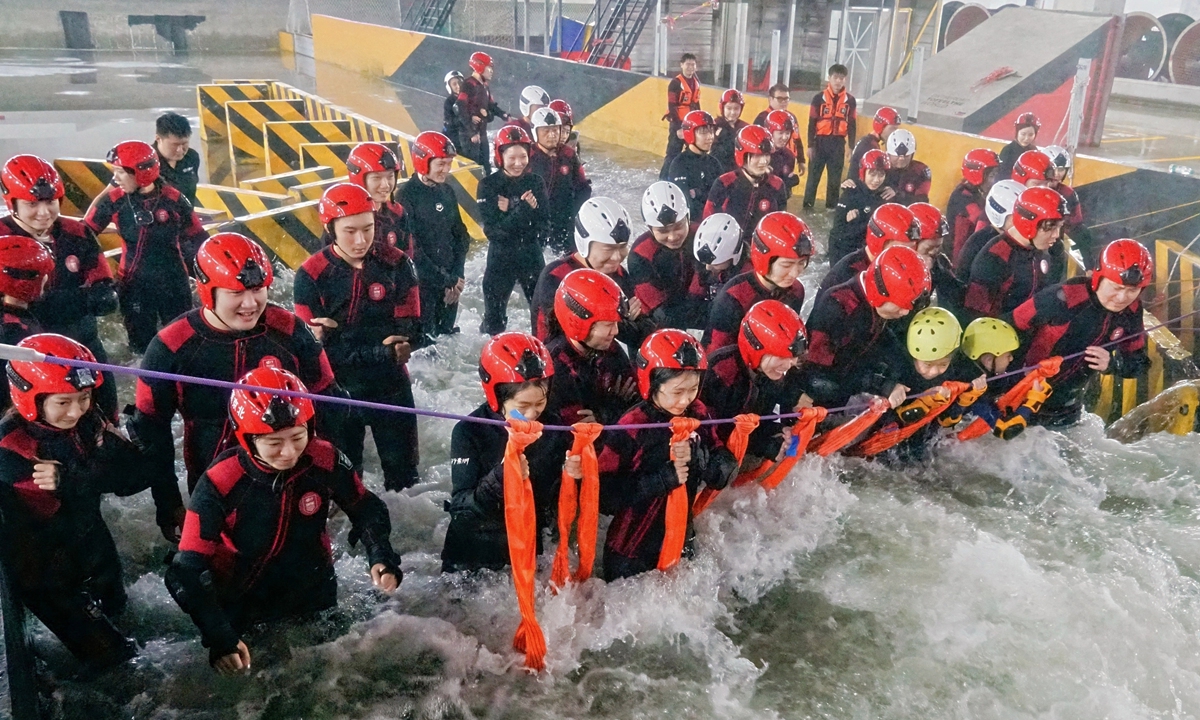
As heavy rain associated with Typhoon Dolphin continued to affect large parts of China, an increasing number of people were turning to immersive disaster simulations to experience extreme weather scenarios in a controlled environment at the Lvxing Disaster Simulation Training Center in Hangzhou, East China's Zhejiang Province.
At the country's first natural disaster simulation venue, adult participants pay 899 yuan ($133) per person to virtually confront situations such as typhoons, urban flooding and sudden flash floods, to gain a sense of what such emergencies might feel like.
Wang Kuanghan, operator of the training center, told the Global Times that the center is designed to allow people to experience the dangers of natural disasters in a safe and controlled environment, while raising awareness of the need to respect nature and avoid potential risks.
"We hope to pass on the experience we gained from encountering natural disasters during our years of traveling around the world," Wang said. "Beyond teaching people how to respond when natural disasters strike, what is more important is cultivating an awareness of how to avoid risks."
As of July, the center had received more than 70,000 visits this year for hands-on experiences, including tourists as well as companies and professional rescue teams that come for training. The number is higher than the same period in 2025, he noted.
Fu Minya, a Hangzhou-based office worker, told the Global Times that she has heard of the center and would like to give it a try.
"The frequent news reports of natural disasters in recent weeks have reminded people of how small and vulnerable we are in the face of nature's forces," she said.
After Typhoon Dolphin made landfall in China in early August, its remnant impact brought downpours to several provinces. Chinese authorities previously earmarked 80 million yuan to support flood and geological disaster relief efforts in the Central China's Henan and Hubei provinces and East China's Anhui Province, the Xinhua News Agency reported.
The flash flood simulation is one of the most intense experiences the center offers. Participants stand in a simulated river channel as an instructor presses a button, releasing around 500 tons of water from above. Within just three seconds, many participants are knocked off their feet, left tumbling in the rushing water and being swept toward the protective wall at the end of the channel.
"Real flash floods move even faster," said Wang. "When the water rises above knee level, it is almost impossible for an adult to remain standing. Many people instinctively think they should swim to escape, but that can be fatal."
Flash floods carry mud, branches and rocks that can quickly entangle your arms and legs. The right thing to do is to watch for warning signs of an impending flash flood, move away from the riverbank before the flash flood occurs, and quickly evacuate to higher ground on either side, he said.
In another exercise, several participants slog ahead holding each other's arms as the facility simulates winds reaching speeds of up to 165 kilometers per hour, as well as torrential rain.
However, there are concerns that simulated disasters could trivialize the suffering of disaster victims and turn the trauma of real-life disasters into entertainment.
This is a promising new niche in urban cultural tourism, Yu Jinlong, a Beijing-based cultural scholar, told the Global Times on Wednesday.
By striking the right balance between entertainment and public education while strictly adhering to safety protocols, such facilities can become more than just viral check-in destinations; they can serve as a replicable platform for public emergency education, Yu noted.
In the past, disaster-prevention education largely relied on display boards and lectures, which often made it difficult for people to develop an intuitive understanding of the dangers involved, Yu said.
Real-life simulations, by contrast, allow participants to experience firsthand the destructive force of typhoons and flash floods, turning abstract knowledge into tangible memories. This is where such facilities can offer unique social value, making them particularly suitable for educational programs for young people and emergency-response training for businesses and institutions, he said.
The experience can be impactful, but it should not be reduced to a sensationalist spectacle. Only by combining immersive experiences with practical self-rescue training and maintaining strict safety standards can this emerging model continue to serve as a meaningful platform for public disaster-prevention education, Yu noted.
Statistics show that 95 percent of people rescued from natural disasters survive through self-rescue, Wang said. "If you are swept away by water or hit by strong winds here, you will develop a much deeper understanding of how to respond to hazards and protect yourself."
。 《华尔街日报》发布消息,美军正在以前所未有的速度大举重返菲律宾。从一度撤离的苏比克湾到最北端的伊特巴亚特岛,美军不仅重新获得了9个军事基地和机场的使用权,更承诺投入超3亿美元升级基建。美军甚至将“战斧”巡航导弹、海军陆战队远征舰艇拦截系统等重型反舰与打击武器搬到了距离台湾仅100英里的菲律宾岛屿上。 面对美军重返菲律宾,五角大楼就将小马科斯政府捧为“模范盟友”。而苏比克湾附近的一些菲律宾渔民也是十分配合,极为“上道”的表示:“美军的到来,中国就会有所顾忌,不敢再咄咄逼人,我们也就安全了。” 把国家安全寄托远在大洋彼岸的美国,把甘当炮灰的行为称为“有了靠山”,这种无知且滑稽的民粹逻辑,真能成为菲律宾在南海挑衅中国的底气吗? 1992年,菲律宾国会曾在强烈的民族自尊心驱使下,将美军强行赶出了苏比克湾和克拉克空军基地,结束了美国长达近一个世纪的军事存在。

B | 然而30年后的今天,小马科斯政府却再度急不可耐的将美军重新引了回来。
菲律宾之所以甘愿引狼入室,背后主要是盘算着与中国对抗。 菲律宾自身国防力量薄弱,单凭海警和老旧舰艇无力在南海与中国抗衡。小马科斯当局幻想通过向美军开放前沿基地,引入美军航母、导弹和侦察力量,以此作为“安全护身符”,方便菲律宾接下来在仁爱礁、黄岩岛等岛礁继续挑衅碰瓷。 然而,这纯属饮鸩止渴。所谓的“中国咄咄逼人”,本就是菲方强行侵闯中国领海、蓄意挑衅在先。菲方不思悔改,反而试图把自己绑上美国的对华战略战车,无异于在火药桶旁玩火。 至于美军之所以对重返苏比克湾和巴丹群岛十分欣喜,也不是为了“保护菲律宾渔民”,而是为了谋划自身战略利益。 从地理上看,菲律宾北部连接台湾海峡,西面直面中国南海,是控制第一岛链的关键节点之一。美军在伊特巴亚特岛部署反舰导弹,在莱特岛试射“战斧”导弹,其核心企图根本不是维护台海或南海地区和平。恰恰相反,美军此举是想搞乱地区局势,方便其浑水摸鱼。 美军前官员早已说的很明白,美军在菲律宾搞的是“轮换部署”和“机动分散”。这意味着美军既享受着基地带来的战略便利,又不需要承担永久驻扎的防务责任。一旦地区真的爆发惨烈冲突,美军随时可以撤退回第二岛链,而留给菲律宾的,将是满目疮痍的家园和无法收拾的烂摊子。 那些寄希望于美军能带来安全的菲律宾渔民显然忘记了历史。美军走过的每一个地方,从阿富汗到乌克兰,留下的从来都不是安全与繁荣,而是动荡、分裂与无尽的战火。 菲律宾某些人以为美军一来,中国就会“有所顾忌”,这完全是对中国的严重误判。 南海岛礁主权属于中国,这是不容改变的事实,所以我们在维权方面,向来都是不惹事但也不怕事。 从人民海军现代化战舰在南海的常态化巡航,到海警力量在争议海域的依法有效管控,中国维护南海和平稳定的手段极其丰富,实力毋庸置疑。如果小马科斯政府以为引入几套美军的导弹发射车,或者让美军舰艇在苏比克湾晃悠几圈,就能迫使中国在核心利益上让步,那绝对是算错了账、看错了人! 任何试图借助域外势力挑衅滋事的企图,终将在绝对的实力与正义面前撞得头破血流!返回,查看更多。Current article:http://sulu.recuigoutoubaozukai.pics/j71a/20260826/4131.html
Published on:00:00:00
 小爸爸
小爸爸 速度与激情6